Laser Level vs. Transit Level for Construction Jobs

Published July 31, 2026
For modern residential and light commercial leveling work, a self-leveling rotary laser level has become the default. While a transit level still shines at vertical angle measurements, laser levels offer better accuracy, faster setup and one-person operation.
This guide is designed to help you confidently make your next measuring tool purchase. We detail the top leveling tools and compare laser levels vs. optical levels and builder’s (dumpy) levels vs. transit levels.
Table of Contents
Defining the Tools: Laser Level vs. Transit Levels
Comparing the Tools: Laser Level vs. Transit Levels
When to Choose a Rotary Laser Level
When to Choose a Transit/Builder’s Level
Standardizing Across a Contractor Business
More Tools. More Products. More Perks.
Defining the Tools: Laser Level vs. Transit Levels
It’s helpful to know some specifics on each type of level when deciding on your next purchase.
Laser Levels
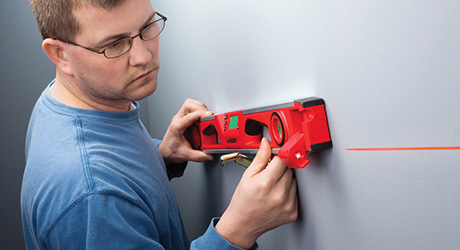
- A laser level emits a self-leveling laser beam that establishes level lines.
- Line laser levels and dot/point laser levels emit a fixed laser line or point. They are typically self-leveling within a small range. Their uses span indoor layouts for door and window heights to tile, drywall, cabinets and ceilings. They have an indoor visible range of 30-100 ft. and their outdoor visible range drops significantly in direct sun without a detector.
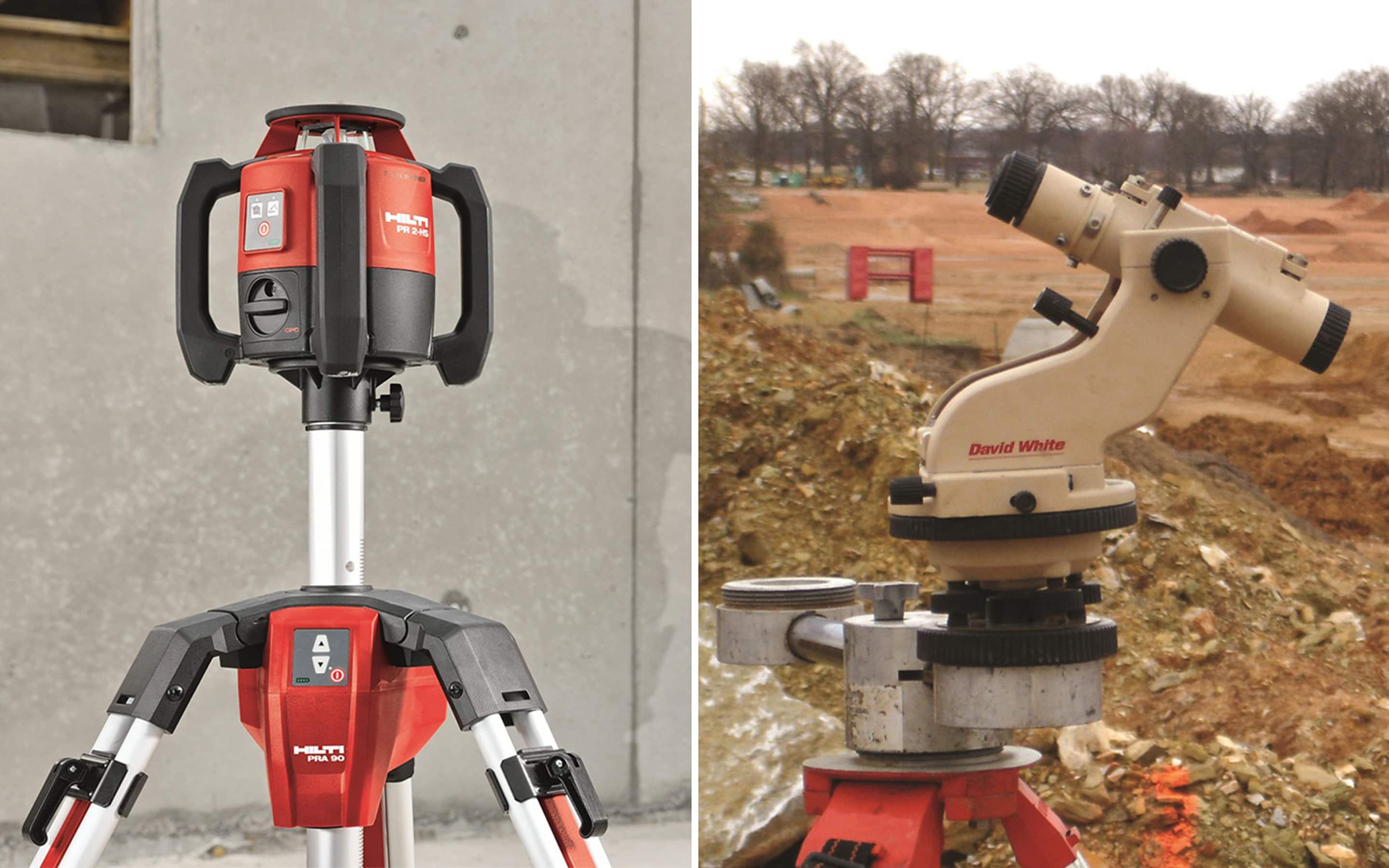
- A rotary laser level is a self-leveling laser head that rotates 360 degrees to project a horizontal plane around your jobsite. When paired with a laser detector (or “laser receiver”) and clamped to a grade rod, the operator can read the beam height at any point in the rotation.
- A dual-grade rotary level establishes two independent slope axes (X and Y) that are used for engineered earthwork, parking lot grading and drainage applications. They are priced higher on average than standard rotary and are typically used in specialized cases.
Transit/Builder’s (Dumpy) Levels
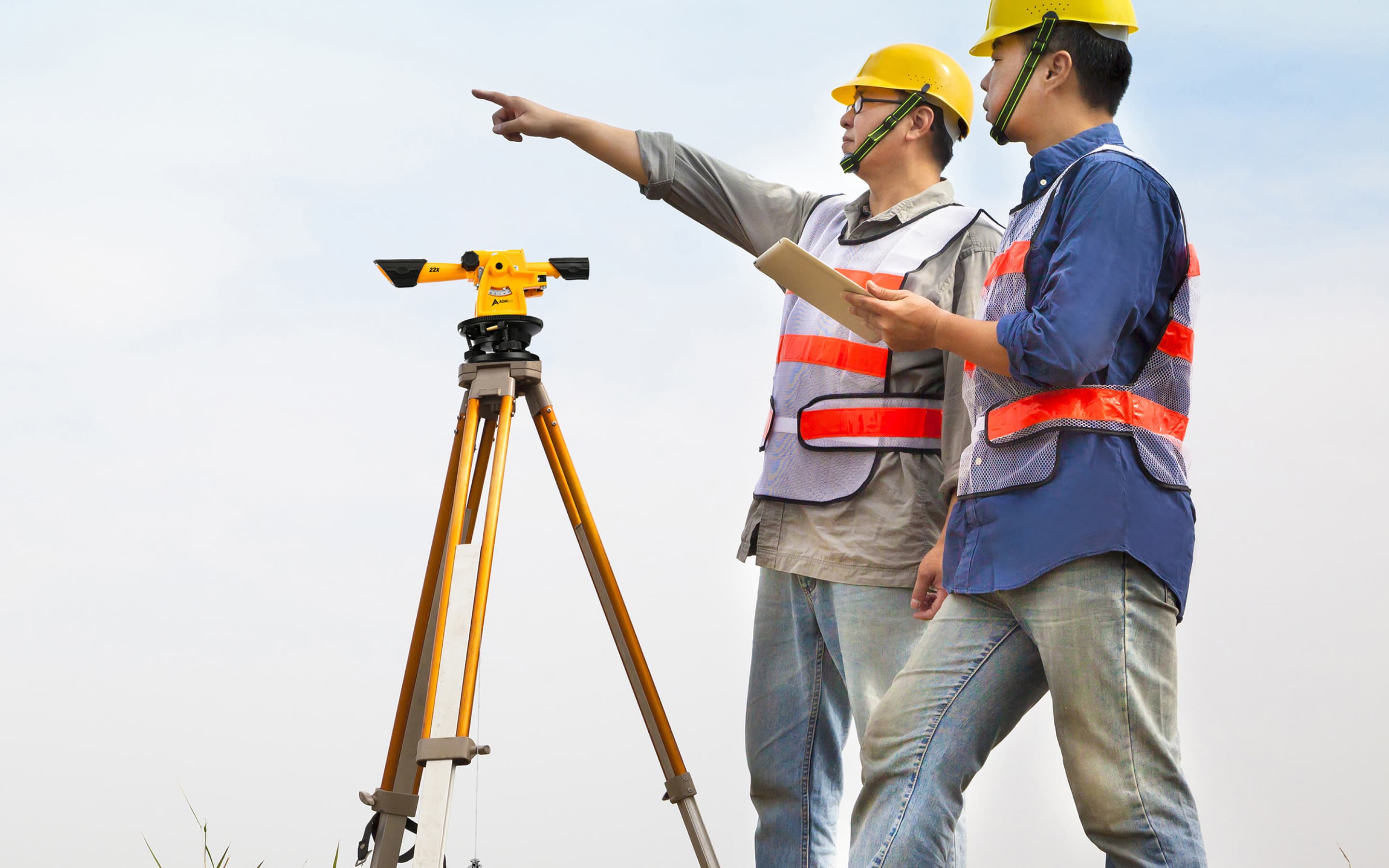
- Transit levels are optical instruments with a telescope mounted on a leveling base.
- Transit level operator sights through the scope to a graduated rod held vertically at the point of being measured.
Tripods are essential for using either a transit level or laser level.
Consider these key facts:
- Tripods offer needed stability by holding the instruments at a consistent elevation throughout your work.
- Transit levels require a heavy-duty surveyor’s tripod with a flat or domed head matched to the instrument’s base.
- Laser levels work with both surveyor tripods and lighter aluminum tripods that are designed for laser use.
- For grade work over rough terrain, a heavier tripod is key.
- A kicked tripod resets the elevation reference and forces re-setup.
Comparing the Tools: Laser Level vs. Transit Levels
Recognizing where laser levels and transit levels differ from a performance perspective could make adding to, or replacing, your existing tools an easier decision.
Accuracy
- Rotary laser levels typically have an accuracy of ±1/16 to ±1/8 in. per 100 ft.
- Transit levels/builder’s levels typically have an accuracy of ±1/4 in. per 100 ft.
- Transit level accuracy can vary due to its lack of self-leveling and two-person workflow reliance that can result in human errors.
- Modern rotary laser levels can be very accurate if handled by a well-trained operator.
Outdoor Range
- Rotary laser levels typically have a range of 200–2,000+ ft. with a detector. Line and dot lasers without detectors typically reach 30-100 ft. of usable visible beam in shaded conditions.
- Transit levels/builder’s levels typically have a range of 100-300 ft. with a naked eye reading. With a detector, the outdoor range is about 200-2,000+ ft.
Cost Range
- Entry-level rotary laser levels range from $300-$700, while more professional rotary laser levels with detectors and tripods range from $600-$2,000. Dual-grade rotary lasers range from $1,500-$3,000+ typically.
- Transit levels range from $300-$800 and builder’s levels range from $200-$500.
Operator Count
- Rotary laser levels typically require only one operator.
- Transit levels/builder’s levels typically require two operators (one instrument person and one rodman).
Setup Time
- Rotary laser levels (self-leveling ones) average 2-5 minutes of set up time.
- Transit levels/builder’s levels average 10-20 minutes of set up time, requiring manual leveling with bubble vials and thumbscrews.
Battery Dependence
- Rotary laser level batteries typically last 20-60 hours per charge, depending on the model.
- Transit level/builder’s levels are not powered by batteries.
Vertical Angle Measurement
- Rotary laser levels typically cannot measure vertical angles. Some models offer slope (the ability to tilt horizontally on one axis or two over long distances), but it differs from vertical angle measurement.
- Transit levels can measure vertical angels and its telescope tilts up and down to measure slope angles (or the “optical level”).
- A builder’s level measures horizontal angles and elevations and cannot measure vertical angles.
Durability
- Rotary laser levels depend on functioning electronics, batteries and a self-leveling mechanism that can fall out of calibration if met with hard impact.
- Transit levels/builder’s levels are mechanically simple and can tolerate rough handling. They don’t require batteries and possess no electronic features that could fail or falter in extreme weather conditions.
Calibration
- Rotary laser levels typically require periodic calibration and should be field-checked (with a simple two-point check on a known elevation) at the start of any precision job.
- Transit levels/builder’s levels typically require periodic calibration and should be checked annually by a calibration shop. As durable as they are, it can drift out of tolerance after a serious drop.
Can a laser level replace a transit level? For almost all residential leveling work, yes. They have largely replaced transit levels on modern jobsites. Additionally, they are the go-to for pure leveling and elevation work.
Transit levels are still the front runner when it comes to vertical angle measurement. They are also the top choice for combined horizontal-and-vertical-angle work.
When to Choose a Rotary Laser Level
Consider these scenarios for choosing a rotary laser level.
- Working solo or with a small crew? A rotary laser level only requires one operator. This could help you save significant labor costs across projects.
- Site grading? Rotary laser levels are the modern workhorse for grading, foundations, slab forms, deck post elevations and any work where elevations need to be established at multiple points throughout the site.
- Doing indoor work? Rotary laser levels use a line/dot laser that is optimal for handling ceiling and partition elevations.
- Need a long-range outdoor read? A rotary laser level’s range with a detector outperforms the transit level’s naked-eye reading distance for foundation corners on a large site and leveling across an addition.
- Have a highly-trained crew? Modern crews most likely know how to use a rotary laser level already.
When to Choose a Transit/Builder’s Level

Consider these scenarios for choosing a transit/builder’s level.
- Need a vertical angle measurement? A transit level sets slopes, plumbs tall structures and measures grade angles on retaining walls. A builder's level does not have this functionality.
- Working in extreme conditions? A transit level can withstand heat, cold, dust and doesn’t require charging access. Its simplicity and reliable mechanics are an advantage where a laser level’s electronics may fail.
- Doing specialized work? A transit level works for pool grading and certain precision applications where experienced operators may prefer the deliberate workflow of optical sighting.
- Training your team? A transit level teaches the discipline of survey-level reading and rod work. This practice could help them operate any leveling instrument well in the future. Some general contractors keep a transit level specifically for crew training.
- Need a backup tool? Keeping a transit level on the truck means a dead battery or a damaged laser won’t stop a day's work.
Standardizing Across a Contractor Business
Being up to date on modern setups and tactics can help your business stay current and effective.
Here are some key facts on modern standardization:
- Established residential general contractors are standardizing on self-leveling rotary lasers with detectors as their primary outdoor leveling tool. They are carrying one or two cross-line lasers for indoor layouts like door heights, tile and cabinets. The transit level-only setup is becoming extinct, with most GC's using it strictly for vertical angle work.
- When it comes to equipment per crew, stocking one rotary laser system (instrument, detector, tripod, grade rod) per active crew and cross-line lasers per truck or per finish carpenter is becoming standard. The total measuring-tool kit per crew cost is typically landing between $1,500 and $3,500 for pro tools.
- New crews are now almost universally trained on laser levels first. Pairing new crew members with experienced operators on a transit level at least once during training can build reading discipline that could improve their laser work too. This is small training cost that could have a solid ROI.
- An effective measuring-tool program includes annual calibration checks for transit levels and a documented field-verification routine for laser levels. This would include a simple two-point check on a known elevation at the start of any precision job. The cost of recalibration is generally small but the cost of a concrete slab poured based on an out-of-calibration laser measurement can be significant.
More Tools. More Products. More Perks.
Be more competitive and boost your bottom line with Pro Xtra, The Home Depot’s loyalty program built for Pros. Sign up today to access the enhanced Pro Online Experience, built with the online business tools and time-saving features Pros need.
Shop The Home Depot for levels, localized delivery and Pro Desk Services in store.