- Orbital sander gives uniform and smooth finish and vibrates less
- Contoured grip provides a safe, firm, and comfortable hold
- Diffused rear exhaust extracts dust and air away from the user
- View More Details
Free & Easy Returns In Store
Return this item within 30 days of purchase.
Ask about this product
Get an answer now with AI
Magic Apron Assistant is an AI virtual assistant. By proceeding, you consent to the recording and use of your information by The Home Depot (and authorized third parties). More information
Product Details
About This Product
Ingersoll Rand's EDGE Series 300G 6" Random Orbital Air Sander is lightweight yet sturdy. This vacuum-ready, low-vibration model produces an ultra high-quality, swirl-free finish and connects to central or portable vacuum systems. The 300G extracts dust and particles through the pad, keeping foreign matter away from the motor. Virtually all dust is instantly channeled away from the work. This pneumatic sander is well-suited for preparing metal and wood surfaces for painting and finishing.
Highlights
- RELIABILITY: The durable design ensures this tool will work like you expect each time you pull the trigger.
- COMFORT: Contoured grip increases comfort while operating, keeping you on the job longer and finishing tasks efficiently. exhaust
- LIGHTWEIGHT: The sander's composite design is lightweight but sturdy, weighing less than 2 lbs.
- Diffused rear exhaust
- 3/16" Orbit
- Return Policy
- California residentssee Prop 65 WARNINGS
Product Information
Specifications
Dimensions: H 4.5 in, W 6.5 in, D 8 in
Dimensions
Air Inlet Size (in.) | 1/4 in |
|---|---|
Handle Length (in.) | 0 |
Product Depth (in.) | 8 in |
Product Height (in.) | 4.5 in |
Product Length (in.) | 8 in |
Product Width (in.) | 6.5 in |
Details
Hose Included | No |
|---|---|
Housing Material | Composite |
Included | No additional components or accessories are included |
Returnable | 30-Day |
Tool Weight (lb.) | 2 lb |
Tools Product Type | Power Tool |
Warranty / Certifications
Manufacturer Warranty | 1 Year |
|---|
Questions & Answers
Is this type of sander can be use to polish car
No, the revolution is to fast as it will burn the paint off .
Does this item have a 6" PSA set up on it?
This sander uses 6" sticky back sandpaper. It can also use hook and loop discs.
need parts to go with it
This sander uses 6" sticky back sandpaper, and you can also switch out the backing pad with a hook and loop style for velcro-type sandpaper. Ingersoll Rand offers a variety of different attachments and accessories. I recommend checking the manufacturer's website for specific parts and accessories compatible with the 300G model.
How do you switch out the pad to accept hook and loop sandpaper?
the tool come with a flat thin wrench that loosens a nut, see instructions below. https://www.ingersollrandproducts.com/en-us/power-tools/edge-series-tools/sanders/300g.html
Loosen central bolt, remove pad, replace, tighten bolt... you're back in business! ;-)
What size air compressor do I need to use this sander?
If u want use it continuously I would suggest at least a 60 gallon compressor, I have a 60 gallon that puts out 12cfm at 90psi and this sander still taxes my compressor.
Any compressor capable of 40 CFM @ 90 PSI will work. The advantage of a larger compressor with a larger tank is, it will not need to cycle on so often. These can be run on relatively small compressors. However, the small compressor will need to stay on almost constantly, which is noisy and causes premature wear. Some small compressors will "thermal off" if they get too hot from constant running. A good rule of thumb for compressors is, always buy twice what you need. In other words, take the air-tool with the highest input requirement, double that, then choose a compressor in that range. That is only a rough estimate and does not need to be exact. Another helpful tip here is: Always check the manufacture's specifications and manuals. Those are available online for just about every tool nowadays. The Home Depot website also provides links to many manuals on product spec pages, so they're even easier to find fast. Money-saving tip: Consider the application. If you plan to use only one tool at a time (as in a small one-person shop) then you can reduce your overall air supply capacity. In larger shops (with multiple users at several stations and with multiple air-outlets) a larger capacity compressor is a good investment. Practical tip: When selecting a LARGER compressor for a large shop with many outlets from a distributed air source, the efficiency of the system comes into play. Any air-leaks around nozzles or fittings will reduce efficiency. So, we need to make sure all fittings are tight-and-right to maintain adequate air flow. That prevents your compressor from working too hard and provides optimum performance from your air-tools. Teflon "plumber's tape" is inexpensive. So is any liquid detergent that we use for revealing leaks. These set-up and maintenance procedures take less than two minutes per fitting... WELL worth the time and effort! If we check and service our systems once a year, it pays off in lower energy costs and higher efficiency. That also means you do not need to buy too much compressor for your application, so that simple cheap service regimen saves money up-front and for years to come. Hope that helps! It's really not too complicated when you think about it. I just offer these thoughts from practical experience. Good luck! ;-)
Is air consumption really only 4 CFM? I see this spec all too often on air tools, when in reality they consume MUCH more air.
You are correct. That spec is probably a typo. I believe the real spec is closer to 40 Cubic Feet per Minute, not 4. I did some quick napkin calculations based on 1/4" interior hose diameter with 4 CFM at 90 PSI.. That would barely be enough to turn the disk, much less do any meaningful work. My experience with this and others like it shows, you CAN use a small compressor, but it stay on almost constantly. In a confined space that noise may be uncomfortable. For all practical applications, a larger compressor is better. I run mine with a 10 gallon 1/4 HP compressor at 110PSI with good results.
Can you switch out the sticky back plate for a hook and loop plate?
yes you can switch out the backing pad with hook and loop for Velcro type paper
There is nothing in the instructions regarding switching out the back plate.
Yes! Ingersol makes a full spectrum of different attachments and accessories for every abrasive need. Visit their website to learn more details: https://company.ingersollrand.com Just be sure to follow directions for installation and operation, especially suggested speeds. That's because speed, size, abrasive grit and the material being abraded all factor in to the heat equation, and heat is the crucial problem we try to avoid to prevent poor finishes. I should also point out that, most professionals just buy a dedicated sander for special needs because these are inexpensive compared to electric sanders. That's one of the benefits of air-powered tools. The compressor provides power so we don't have to buy another motor for each tool. That allows users to switch entire tools as fast or faster than switching abrasives with hook & loop pads. I hope that helps you get want you want for good results and maximum efficiency!
Does it have a built in rpm/air flow controller?
No it does not, it only has a variable speed trigger which does work very nicely. But you can add on an aftermarket air flow regulator if you want to. I used mine for years with just the variable speed trigger and it worked just fine for me, occasionally I would turn down the pressure at the air regulator I had on the wall that my air hose connected to but not very often because the variable speed trigger on it is really nice and works great.
Viewing 1-8 of 10
Customer Reviews
4.5 out of 5
Loading Recommendations
Compare Key Features
Product Snapshot | |||
|---|---|---|---|
Great for surface prep, this lightweight, low-vibration sander delivers a swirl-free finish. Ideal for DIYers and pros. | Ideal for surface prep, this orbital sander minimizes vibration and noise for comfortable use, featuring a lube-free motor and ergonomic grip. | Ideal for professionals and DIYers seeking reduced vibration and noise with a patented lube-free motor for extended tool life. | Great for surface prep, this orbital sander minimizes vibration and dust for comfortable, efficient use. |
Power Output | |||
Orbital Action | |||
Dust Collection System | |||
Pad Size | |||
6 in. | 6 in. | 6 in. | 6 in. |
Weight | |||
2 lb | 1.9 lb | 1.8 lb | 1.9 lb |


Related Products

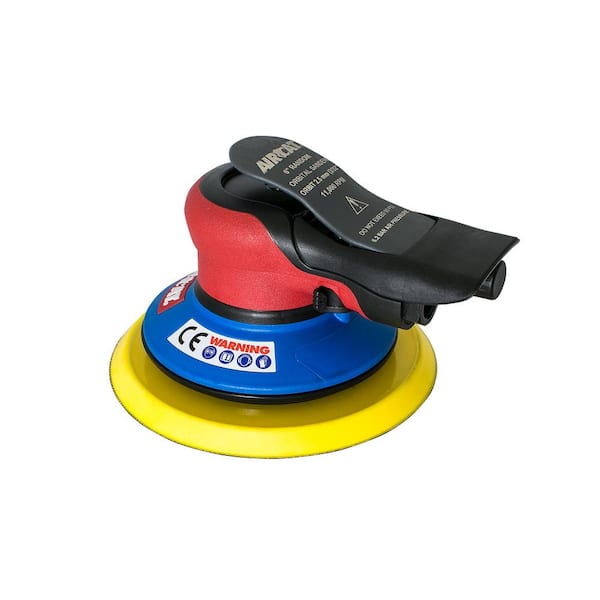
Composite 6 in. Orbital Palm Sander 3/32 in. Orbit
AIRCAT has developed a series of lubrication free sanders that incorporate the latest engineering concepts, advanced materials and patented designs. The AIRCAT technology reduces weight, noise and vibration, while extending the tool life. The AIRCAT smooth design throttle lever and the ergonomic grip featured in this orbital sander provides unmatched operating comfort and lowest air consumption and vibration in this class. Patented lube-free motor.
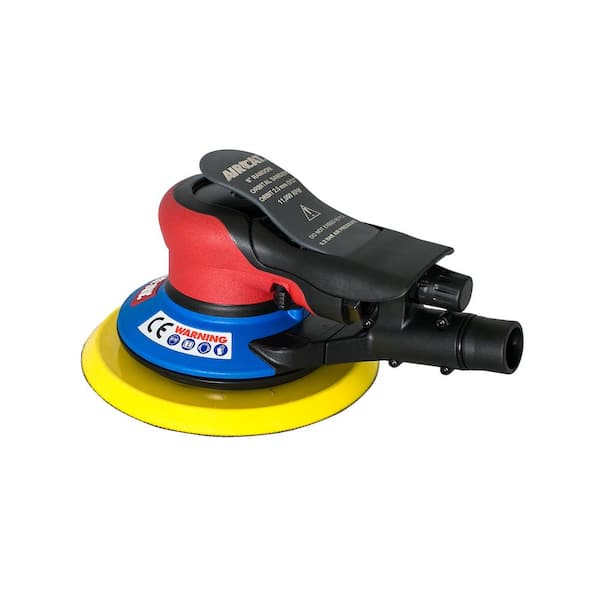
Composite 6 in. Central Vac Orbital Palm Sander 3/32 in. Orbit
AIRCAT has developed a series of lubrication free sanders that incorporate the latest engineering concepts, advanced materials and patented designs. The AIRCAT technology reduces weight, noise and vibration, while extending the tool life. The AIRCAT smooth design throttle lever and the ergonomic grip featured in orbital sanders provide unmatched operating comfort and lowest air consumption and vibration in this class of Sanders. Patented lube-free motor.

Composite 6 in. Central Vac Orbital Palm Sander 3/16 in. Orbit
AIRCAT has developed a series of lubrication free sanders that incorporate the latest engineering concepts, advanced materials and patented designs. The AIRCAT technology reduces weight, noise and vibration, while extending the tool life. The AIRCAT smooth design throttle lever and the ergonomic grip featured in orbital sanders provide unmatched operating comfort and lowest air consumption and vibration in this class of Sanders. Patented lube-free motor.

R12 JAT-731 6 in. Round Palm Sander
Rated to last for those demanding 12-hour days, the R12 Series air tools are built to tackle the most extreme jobs. Engineered for Overtime, these tools feature the superior strength and durability needed across a wide range of applications. Jet backs this product with its Red Assurance Lifetime Warranty.