- Suitable for permanent use, camping, worksites, cars, and boats
- Includes a detailed instruction manual for convenient set-up
- 5 protection systems ensure safe and reliable use
- View More Details
Free & Easy Returns In Store
Return this item within 90 days of purchase.
Ask about this product
Get an answer now with AI
Magic Apron Assistant is an AI virtual assistant. By proceeding, you consent to the recording and use of your information by The Home Depot (and authorized third parties). More information
Product Details
About This Product
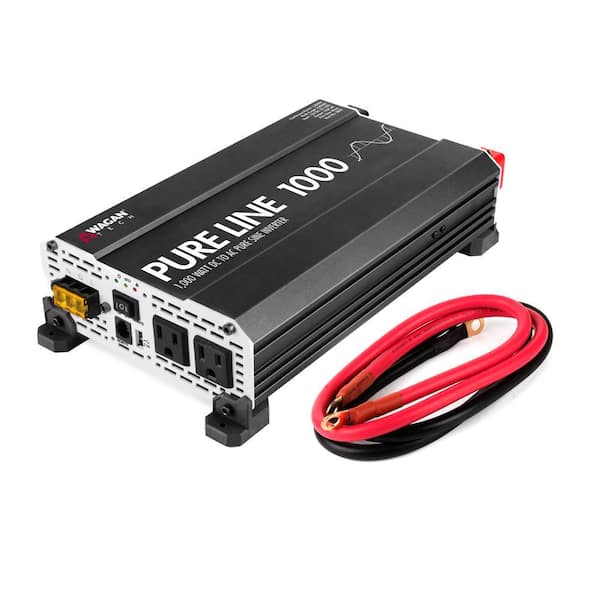
GoWISE Power power inverter is an advanced tool of power conversion. It can supply you with AC power converted from a DC power source. It can be used in cars, vessels, during camping and in power failure emergencies. Pure Sine inverters are a stable power source with 1000-Watt continuous power and 2000-Watt surge power with low harmonic distortion. This inverter is an excellent tool to use during power failure emergencies and guarantees maximum efficiency with computers, sensitive equipment and more. Compact and portable, this inverter can be used on worksites, boats, cars, camping or for permanent use. The PS1002 features 5 protection systems: Thermal protection, Overload protection, Over Voltage protection, Under Voltage protection, Low Voltage protection alarm. Inverter also comes with an LED light that indicates the problem. Your purchase comes with black and red cables with ring terminals, a remote switch, an inverter with 2 AC sockets and 1 USB port 5-Volt and a detailed instruction manual.
Highlights
- GoWISE Power advanced technology pure sine power inverter 1000-Watt continuous/2000-Watt surge, 12-Volt DC to 120-Volt AC with black and red cables with ring terminals, remote switch, 5 kinds of protection systems and 3 output sockets
- Ideal for use in cars, vessels and for power failure emergencies. Guarantees maximum efficiency with computers, sensitive electronic equipment and more
- 5 protection systems: thermal protection, overload protection, over voltage protection, under voltage protection, low voltage protection alarm, inverter comes with an LED light to indicate the problem
- Total Harmonic Distortion (THD) 3%; soft start low interference tech and temperature control cooling fan, output voltage: AC 120-Volt; frequency: 60Hz
- 2000-Watt surge power, 1000 continuous power; inverter comes with black and red cables with ring terminals, remote switch and 2 AC sockets and 1 USB Port 5-Volt, 1000mA and a detailed instruction manual for set-up
- Before purchasing, check the maximum amperage of the intended battery. It is the responsibility of the consumer to be knowledgeable on the specifications of the battery and its compatibility with GoWISE Power Inverters. If unknown, we recommend reaching out to the battery manufacturer.
- Return Policy
Product Information
Specifications
Dimensions: H 3.5 in, W 8.25 in, D 11.5 in
Dimensions
Product Depth (in.) | 11.5 in |
|---|---|
Product Height (in.) | 3.5 in |
Product Width (in.) | 8.25 in |
Details
Automotive Part Type | Power Inverter |
|---|---|
Product Weight (lb.) | 4 lb |
Returnable | 90-Day |
Running Wattage | 1000 |
Voltage (V) | 12 |
Warranty / Certifications
Manufacturer Warranty | 1-year limited warranty |
|---|
Questions & Answers
Can I connect two of them together in parallel?
I don't think so. I am a casual user of several power inverters; and have found out that, unless they have hard wire terminals, they generally are not compatible with "house wiring". This is because they output their voltage, and current differently that the power company. For example: I have found that if you test the output plug on a power inverter, with a 3 prong tester, you will see that they may be testing out as having a hot, and neutral reverse, and probably an open ground. I think that it is general good practice, to use these types of inverters individually, with a cord going directly to what you are going to power with it. If you want to power a camper, for example; you should research the web for good grounding suggestions. For safety; if you are powering into a camper, for example, you should probably use a ground rod, and tie in the inverter ground, as well as the battery ground, to the ground rod. If you are powering an individual device, just an extension cord will power your device, but it will probably not be grounded. Sometimes, an external GFCI can be plugged in, and your device plugged into that. Getting back to your question about stacking the inverters: Some solar setups "stack" power inverters, of the "grid tie" type. This inverter, is the "off grid" type, and is different. You could search these terms, on the web, and find out more. My suggestion would be to consider a gas generator, of the appropriate size, if you need a substantial amount of power. Alternatively; larger power inverters are available, but pricey. Good luck, and best regards (a fellow inverter user)
Where can I find a list of devices that it will power?
Hello, Sorry for the delayed response! You can go to our website for more information on devices it will power. Thank you! https://gowiseproducts.com/products/power-tech-on-advanced-technology-pure-sine-power-inverter-ps1004?variant=4368312581
HI: you can somewhat figure this out by adding up the wattage of the device(s) you want to power, and adding 20% to the total you came up with. This gives you a 20% reserve for your inverter, so you don't overload it. Keep in mind that anything with a motor, will need a lot more power than the running watts of the device, because they draw a larger surge of power to start the motor. A helpful device to determine the running watts of your devices, is the Kill a Watt power meter. I think these are available at Home Depot, as well as other sellers. There are also general listings available, to help estimate power usage, but these lists are not accurate enough to base a decision for equipment purchase. Check the device(s) you want to run for the rating label, to see the power used by the device.
Viewing 1-2 of 2
Customer Reviews
4.2 out of 5
5
8
4
6
3
1
2
2
1
0

Loading Recommendations
Compare Key Features
Product Snapshot | |||
|---|---|---|---|
Ideal for sensitive electronics and power outages, this pure sine wave inverter offers reliable 1000W continuous/2000W surge power with multiple protections. | Ideal for powering sensitive electronics during outages or mobile use with pure sine wave output and LCD display. | Ideal for sensitive electronics and power outages, this pure sine wave inverter offers 1500W continuous/3000W surge power with 3 AC outlets and USB charging. | Ideal for powering sensitive electronics with pure sine wave output, overload and short circuit protection for added safety. |
Power Output | |||
1000W continuous/2000W surge | 4000-Watt | 1500W continuous/3000W surge | 1000-Watt |
Number of Outlets | |||
2 AC outlets and 1 USB Port | 2 | 3 | 2 |
Continuous vs. Peak Power | |||
1000W continuous/2000W surge | 2000-Watt continuous / 4000-Watt peak | 1500W continuous/3000W peak | 1000-Watt/2000-Watt |
USB Ports | |||
Pure Sine Wave | |||


Related Products

2000-Watt Continuous 4000-Watt Surge Peak Power Pure Sine Wave Inverter w/Digital LCD Display
The GoWISE Power inverter can supply you with AC power converted from a DC power source. It can be used in cars, vessels, during camping and in power failure emergencies. Pure Sine inverters are a stable power source with 2000-Watt continuous power and 4000-Watt surge power with low harmonic distortion.

3-Outlet Pure Sine Wave Inverter 2,000-Watt Continuous/4,000-Watt Peak with 5-Volt USB Port
GoWISE USA power inverter is an advanced tool of power conversion. It can supply you with AC power converted from a DC power source. It can be used in cars, vessels, during camping and in power failure emergencies. Pure Sine inverters are a stable power source with 2000-Watt continuous power and 4000-Watt surge power with low harmonic distortion. This inverter is an excellent tool to use during power failure emergencies and guarantees maximum efficiency with computers, sensitive equipment and more. Compact and portable, this inverter can be used on worksites, boats, cars, camping or for permanent use. The PS1003 features 5 protection systems: Thermal protection, Overload protection, Over Voltage protection, Under Voltage protection, Low Voltage protection alarm. Inverter also comes with an LED light that indicates the problem. Your purchase comes with black and red cables with ring terminals, a remote switch, an inverter with 3 AC sockets and 1 USB port 5-Volt and a detailed instruction manual.

3000-Watt Continuous 6000-Watt Surge Peak Power Pure Sine Wave Inverter w/Digital LCD Display
The GoWISE Power inverter can supply you with AC power converted from a DC power source. It can be used in cars, vessels, during camping and in power failure emergencies. Pure Sine inverters are a stable power source with 3000-Watt continuous power and 6000-Watt surge power with low harmonic distortion.
12-Volt DC to AC 600 Pure Sine Inverter
Pure sine wave inverters provide premium power that is identical to or even better than power supplied by your electric company. It connects directly to a 12-Volt DC battery to power laptops, televisions, Power Tools, certain air compressors, any audio/video electronics and small appliances in your vehicle. With this Power Bright Inverter, you will never be left without power when you need it.