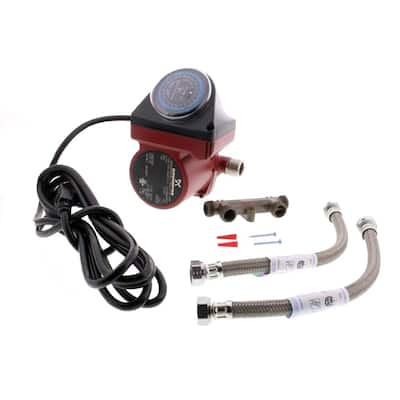
- Grundfos
- Model 595916
- Internet #302859594
- Store SO SKU #1002692908
Product Images
UP15-10SU7P/LC 3/4 in. NPT 115-Volt Comfort Hot Water Recirculation Pump

- Pump made from stainless steel for enhanced durability
- Ideal for homes with no recirculation line for hot water
- Installs quickly, with installation time less than an hour
- View More Details
Free & Easy Returns In Store or Online
Return this item within 90 days of purchase.
Ask about this product
Get an answer now with AI
Magic Apron Assistant is an AI virtual assistant. By proceeding, you consent to the recording and use of your information by The Home Depot (and authorized third parties). More information
Product Details
About This Product
The Grundfos Comfort System is designed to eliminate the wait for hot water at the taps in existing homes with no recirculation line. The stainless-steel recirculation pump connects to a standard tank-style water heater. A thermostatic bypass valve is installed at the sink or fixture furthest from the water heater. Kit includes pump with line cord, 24-hour digital timer, 1 under-sink bypass valve, 2 valve mounting screws, and 2 flex connect hoses.
Highlights
- No return line required
- Installs in less than 1 hour
- No electricity needed under the sink
- Digital plug-in wall timer and line cord
- Uses less energy than a 25-Watt light bulb
- Return Policy
- California residentssee Prop 65 WARNINGS
Product Information
Specifications
Dimensions: H 5.4375 in, W 6.25 in, D 6.25 in
Dimensions
Product Depth (in.) | 6.25 in |
|---|---|
Product Height (in.) | 5.4375 in |
Product Width (in.) | 6.25 in |
Details
Accessory Type | Recirculation Pump |
|---|---|
HVAC Product Type | HVAC Pump |
Pack Size | 1 |
Product Weight (lb.) | 5.51 lb |
Returnable | 90-Day |
Warranty / Certifications
Manufacturer Warranty | Limited Warranty |
|---|
Questions & Answers
Can this be used for my Rinnai Combi boiler iP120199C?
Can this unit work without a timer
If you are asking if you can plug the pump in and let it run constantly the answer is Yes. Constant circulation is a methodology employed in some applications. The transfer valve will close when hot water reaches it. The pump will then dead head, meaning it will push against a closed valve. This is a wet rotor water lubricated pump. This means the pump will not be harmed if it runs in a no flow application.
I use a pressure reducer on the cold water supply line to the hot water heater -- I have pex tubing for a radiant heating system and the street pressure is too high. This pressure reducer only alters the pressure for the hot water, the cold water supply to the house does not go through it. When I installed this the pressure from the street was ~80 psi, I reduced it to ~55. Will the pump still be able to push water back through the cold water line if the pressure from the street on the cold water side is 80 psi and the pressure set on the hot water side is 55 psi?
There is a lot to unpack based on what you have said. Lets start with the house. Residential pressure should be between 40 and 60 PSI. A pressure reducing valve would therefore be appropriate to reduce the incoming potable water pressure to the entire home. Although 80 is not super high, for example my home is 110, it could certainly put undue stress on solenoid valves, washing machine hoses and other possible leak points. As to your radiant heated zone. It sounds like you have a closed loop hydronic heated zone. If that is the case, you would reduce the pressure to 15 psi, not 55 as that would be inappropriate for a closed loop heating system. Thus I am a little confused as to what you actually have going on. But feel free to give me a call. As to your specific question. Circulators create flow within circuits that have a consistent pressure throughout. Thus the circulator is not intended to fight pressure differentials. But by the same token I have never heard of a common system operating with two different pressures simultaneously. Chris 978 651 3301
Everything shows the pump being installed at the water heater. Is there any reason that the pump cannot / should not be installed at an alternate location along the hot water line? For the faucets where I would want to have this functionality it would be convenient to install the pump ~25' from the water heater on the hot water line, there is an power outlet available there so that I wouldn't need to get an outlet to there the water heater is.
No it does not have to be installed on or at the water heater that is just a logical location where it is typically put. Pumps create pressure drop and water moves to pressure drop. So once the pump comes on water will flow through the circuit to balance out the pressure. The pump can essentially be anywhere on the circuit. The key is understanding the layout of piping structure, so the water flows to all the places you want it to. People will sometimes call and say that the system works great. but they are not getting hot water to all the baths. This has to do with the plumbing layout. The water is taking the path of least resistance rather than going where you want it to go. As these units are most often used in retrofits, you often do not know the structured plumbing layout that is preexisting behind the walls. So it becomes trial and error.
Does the new separate digital timer that plugs into the wall outlet require WiFi to communicate with the pump?
No it does not require WIFI nor does it utilize WIFI. A new WIFI model is coming but it is not yet available.
Should this be installed since I have a water softener?
I am sorry but I am not sure I understand the nature of your question. There are different types of contaminant that increase waters hardness, just as there are different types of systems and processes for mitigating hardness. I am unaware of any problems posed by softened water to a water lubricated recirculation pump such as this one. But if you have concerns you may want to put that to the maker or servicer of the specific softening system you have. Addressing your question from a different perspective. If your concern is that the return water would go through the softener for a second time. I would say that is not a good idea and would not be beneficial. However whether or not that occurs would depend on your homes piping schematic. Typically all the incoming water is softened. The filtration system is the first thing in line. Then the water either goes to the cold lines or the hot side of the system. As you typically install these systems such that water recirculates from the furthest point back to the water heater, the water should not be routed back through the softener. But as every home is piped differently I can not give you a definitive answer about your home without being on site.
Can the pump be installed on a horizontal pipe?
Water lubricated pumps can be installed in many different orientations. There is only one that does not work. If you look at the pump you see a round black tag that has the name Grundfos on it as well as the UL logo. The pump can not be installed with that label facing up towards the ceiling. It it is the water lubrication jacket will not fill. So if you want to install it on a horizontal pipe, vertical pipe, diagonal pipe those are all fine. Just don't have the but end of the motor facing straight up.
Is there on demand functionality? My shower times are not on a fixed schedule. If so, is there a physical button or only wifi?
Not with this product but there are many different products that do this same thing that do have varying degrees of technology; such as you describe. When this specific product is employed people typically have the pump cycle every hour or half hour to insure there is always hot water in the line. Now you may intuitively say that is a waste of electricity But if you look at the wattage this pump draws it is not that significant when you consider that you may only be running it 5 minutes an hour.
Viewing 1-8 of 20
Customer Reviews
4.4 out of 5