Product Images

- Features a wall-mount alarm for convenience
- Made of PVC for enhanced durability
- Efficiently draws 2 gal. of sump water per 1 gal. used
- View More Details
Free & Easy Returns In Store or Online
Return this item within 7 days of purchase.
Ask about this product
Get an answer now with AI
Magic Apron Assistant is an AI virtual assistant. By proceeding, you consent to the recording and use of your information by The Home Depot (and authorized third parties). More information
Product Details
About This Product
The SumpJet (Model SJ10A) is a water powered back-up sump pump that will protect your basement in the case of a power outage. This unique product is powered by your municipal water supply and requires no electricity to operate. With a compact high efficiency design, The SumpJet removes 2 gal. of sump water per 1 gal. used. The SumpJet is fully automatic, arrives completely assembled, and comes backed with Liberty's standard 3-year warranty.
Highlights
- SJ10 pumping performance varies with inlet water source pressure and pumping head, see complete specifications and performance chart for expected flow rates
- SJ10 requires an uninterrupted water source to operate, if you have a well pump, the SJ10 will not operate during power outages
- Adjustable stainless hose clamp for easy mounting
- Removes 2 gal. of water for each 1 gal. used (based on 5 ft. lift)
- Fully assembled, compact design
- Built-in screen with removable foot valve
- Constructed of durable PVC
- Return Policy
Product Information
Specifications
Dimensions: H 21.6 in, W 5.1 in, D 14.5 in
Dimensions
Product Depth (in.) | 14.5 in |
|---|---|
Product Height (in.) | 21.6 in |
Product Width (in.) | 5.1 in |
Details
Amperage (A) | 0 |
|---|---|
Battery Life (hours) | 0 hr |
Battery Type Required | Battery Not Included |
Discharge Flow @ 0 ft. (gallons/hour) | 660 |
Discharge Flow @ 0 ft. (gallons/min) | 11 GPM |
Discharge Flow @ 10 ft. (gallons/hour) | 330 |
Discharge Flow @ 10 ft. (gallons/min) | 5.5 GPM |
Housing Material | Other |
Impeller Material | Not Applicable |
Included | No Additional Items Included |
Product Weight (lb.) | 3.5 lb |
Returnable | 7-Day |
Voltage | No Voltage |
Warranty / Certifications
Certifications and Listings | No Certifications or Listings |
|---|---|
Manufacturer Warranty | Limited Warranty |
Questions & Answers
Pump is leaking, drop by drop it clogged my outlet as it froze from the outside in the winter time. Made it useless. Is there a way to repair the pump from leaking? It is just 2 years old…
When water freezes it exerts roughly 30,000 PSI. When it comes to ridged materials, only the most extreme can withstand that type of pressure. For this reason, the best and most common way of frost proofing an item is by making sure it does not freeze, by using things like tracing cable. There is no specific kit to fix this or most appliances if they suffer freeze damage. Basically, you need to find the damage and fix the specific leak. Further freeze ups are not consistent because of the strange rules of thermal dynamics. As a plumber I have fixed many frozen pipes. You would think that most of the time the frozen pipes would be on the outside walls of a home. But just as often I find the freeze up on an interior wall or at a location that does not appear to be the coldest point. It’s very odd and counterintuitive. My point is that when these units freeze up, they will not always break in the same place.
How much is cost to install average price?
I am sorry, even though I have done plumbing for decades I cannot give you an answer with any degree of confidence. The cost of plumbers varies tremendously both by the level of talent and geographic location. And every installation is different. If the application is simple and the installation is part of a larger pluming project, done by an inexpensive plumber this could cost a few hundred dollars. If, however, it is a complex installation where a water supply needs to be plumbed to the location, by a quality shop in a high demand market it could reasonably run well over a thousand. There is just no way to guess without further information. I would suggest you call a few qualified licensed plumbers and ask for a quote. That is the best way to get a definitive answer.
In the notice section of the installation instructions, it says that a device to prevent water hammer should be installed. What type of water arrestor is recommended? And where should this be placed?
For the sake of others that may review your question, and this answer lets back up just a bit. Water hammer is a banging noise or the rattling of pipes you get when valve closes. It is the result of kinetic energy, which is the energy of motion. When a valve closes, especially if it closes quickly, the forward movement stops abruptly. The kinetic energy forms a shock wave moving backwards. The higher the water pressure and volume, the greater the amount of kinetic energy and the greater the water hammer. The water pressure in my home is extremely high; 110 PSI. Even if I close a valve slowly, I experience water hammer. Worse, my home is old and was not plumbed to current specs. The pipes are not supported well so the bang is followed by the lingering vibration of water lines. First, I installed a pressure reducing valve right after my water meter which brought the pressure down in the entire house. At 60 PSI water hammer was greatly reduced but still occurred because the new water main is large and supplies tremendous volume. To reduce hammer further I put a large hammer arrester after the pressure reducing valve to cover the entire house. This eliminated the water hammer except for one toilet. The ball cock valve in that toilet happened to snap shut quickly in such a way that I still got slight water hammer at only that toilet. As this issue had become a personal quest, I added one more hammer arrester right at the valve that supplies that toilet. The addition of that last hammer arrester in close proximity to the point of origin meant I no longer experienced hammer until the shock wave reached the whole house arrester in the basement. Now back to your question. If the manufacturer’s instructions say to install a hammer arrester, I am not going to tell you not to. You would install it on the water line supplying the unit, close to the unit. Personally, I do not install hammer arresters on all my jobs. If I know the water pressure is high, I sometimes install them prophylactically. However, I view water hammer as a symptom of unaddressed excessively high water pressure coupled with bad plumbing. If a customer is experiencing water hammer and addressing the route cause is not possible, I will cut them in to eliminate the system. In your case it may be easier to simply install one as part of the initial installation rather than risking the need to retrofit. You put a tee in the line leading to the unit close to the unit that would tie in the arrester. Be aware that many hammer arrestors need to be installed in a specific orientation. Chris 978 651 3301.
My water lines are 1/2 inch. Will this create enough pressure for the water flow back up sump pump
To make sure I was giving you the right answer I called Liberty’s technical department. They confirmed what I thought. The confirmed that a ¾” supply line is minimum. Half inch just doesn’t have enough capacity.
After 11/2 years all of a sudden my alarm keeps going off. I have changed the battery. Anything else I can do?
The product listing from which your question comes is for a water powered auxiliary sump pump. The pump does not come equipped with an alarm. Therefore, I am at a loss as to what alarm system you have and cannot make specific recommendations. If you are able to identify your alarm and it is a Liberty you can give the take line a call at 585 494 1817. Typically, alarms reset when the high-water issue has been remedied. In my experience when they don’t it is due to a float having become stuck in a position indicating high water. But without knowing what you have that is just a guess.
Do I need to buy another sump pump, or included?
This listing is for a water powered back up pump only. It is intended as a back up to a conventional sump pump that would be purchased separately. The water powered pump would normally be installed in such a way that it would back up the primary sump pump when it either can’t keep up or becomes inactive due to failure or lack of power. If you scroll down the Home Depot product listing page you will come to a section entitled product details. If you expand that section you will find PDFs of the product documents that will give further information about installation and use.
How will the pump perform with a 1/2 water supply line having 65psi?
Pipe size and pressure does not allow me to definitively calculate your flow rate. So I cannot give you a definitive answer. For example I have an 11/4” water line coming into my house at 110PSI yet my flow is only a trickle do to the old and inadequate water main that supplies my house. I would suggest you use a five gallon bucket and a watch to calculate your actual flow rate. A ½ line has the potential to give you 8-10 GPM but potential is not actual.
A water pressure gauge read 62 PSI over 48 hrs. each time I looked at it. The second needle indicating highest pressure recorded kept reading over 200 after I reset it every time. Do I have a problem with water pressure spiking? How do I correct it?
You certainly do have a pressure problem if you are hitting 200 PSI. However, I doubt your municipal water supply is spiking that high and is the source of your problem. Most likely the source is your water heater. You are draining the tank, through use and filling it with cold water that is 62 PSI. That water is then heated and expands. In the old days it would expand backwards into the street. But water meters now have check valves that prevent this so the pressure rises. To prevent pressure from rising the system needs to get larger to accommodate the larger volume created by heat. This is done with a thermal expansion tank. The Amtrol ST12 would be an example. You set the pressure on one side of the tank to the water supply pressure by adding or removing air via the shrader valve. Then when the water expands it pushes against the diagram form the wet side of the tank making the space larger yet keeping the pressure the same. Don’t get me wrong, there certainly could be another reason for this spike. Maybe you have a neighbor opening a nearby fire hydrant, letting it run full and shutting it fast. But that doesn’t sound likely. And if spiking was a problem the water department would know about it and would be requiring or recommending a specific pressure reducing valve. But this sounds like simple thermal expansion. Let me ask you this was your water meter or water heater recently changed and does your heaters pressure relief valve periodically burp out water? If so, those are often associated with thermal expansion. Chris 978 651 3301
Viewing 1-8 of 18
Customer Reviews
4.5 out of 5
Loading Recommendations
Related Products
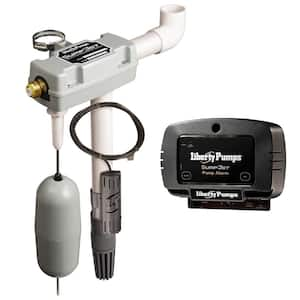
Sump Jet 660 GPH Water Powered Backup Sump Pump with Alarm
The SumpJet115-Volt (Model SJ10A) is a water powered back-up sump pump that will protect your basement in the case of a power outage. This unique product is powered by your municipal water supply** and requires no electricity to operate! With a compact high-efficiency design, the SumpJet 115-Volt removes 2 gallons of sump water per 1 gallon used. The SumpJet115-Volt is fully automatic, arrives completely assembled, and comes backed with Liberty Pumps standard 3 year warranty. The SJ10A requires an uninterrupted water source to operate. If you have a well pump, the SJ10A will not operate during power outages.