Pro Forecast: October 2025 Outlook
Multifamily Gains Momentum
Shop Tools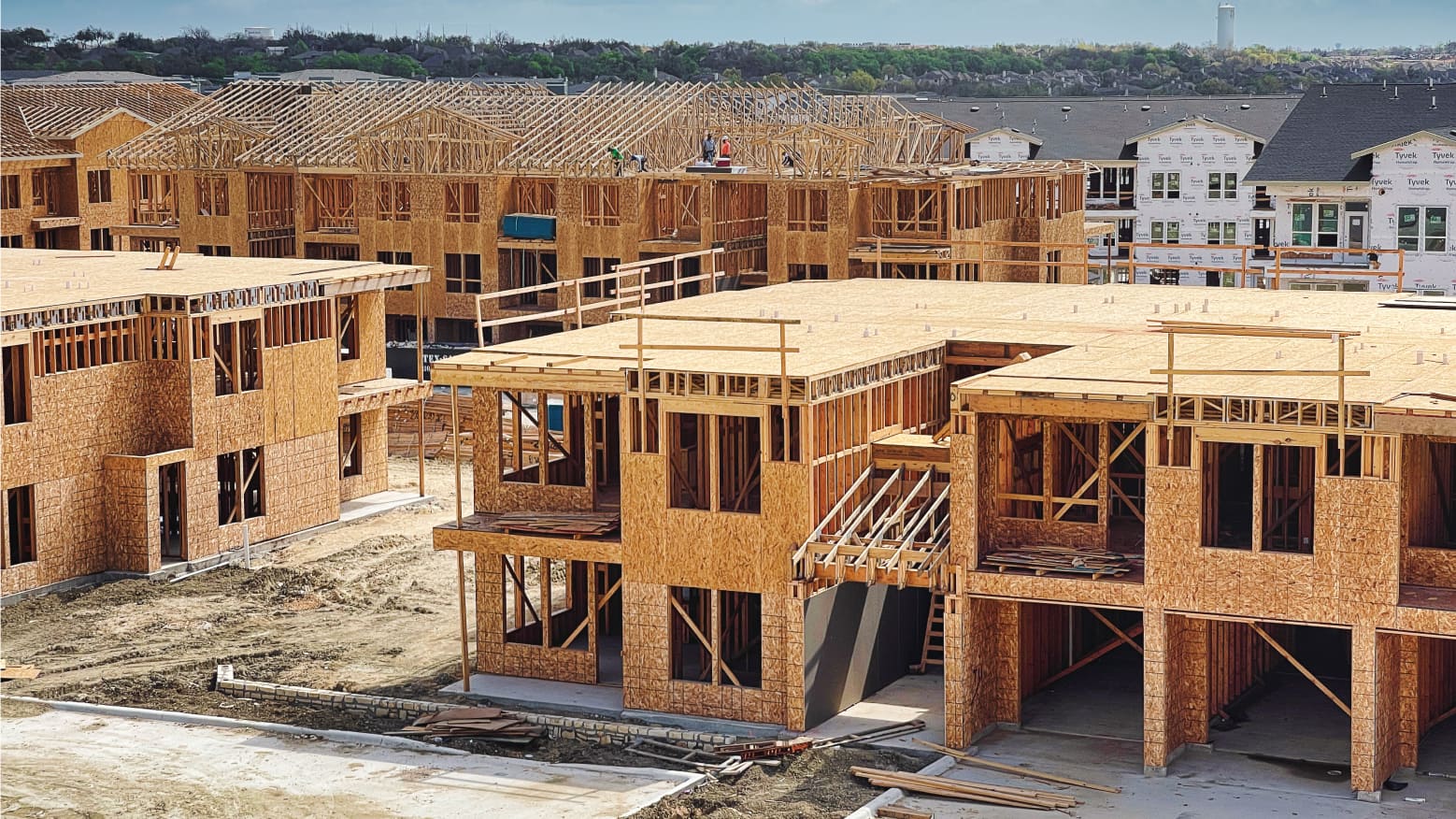
“The Forecast” is a monthly report of industry outlook news to help Pros plan their jobs, keep up with the market and anticipate developing trends.
Key topics in the October Forecast:

HIGHER DENSITY, HIGHER GROWTH
Multifamily housing and townhome construction show more gains compared to single-family declines.

HELP WANTED
Construction wages and employment hold steady despite the slowing housing market.
Multifamily and Townhomes Offer Affordable Options
Multifamily houses and townhomes have both been showing construction gains in 2025, Meanwhile, the rate of single-family builds has been slowing down. Multifamily homes are becoming more popular with potential home buyers faced with affordability challenges. Builder Pros seeking more business should consider expanding into multifamily or townhouse jobs if the zoning in their area supports higher-density projects.
Multifamily housing starts increased twice as much as overall housing starts from 2024 to 2025. Overall housing starts increased 5.2% in July to 1.43 million units, according to the U.S. Department of Housing and Urban Development. Groundbreaking for multifamily projects of five or more units rose 11.6% to an annual rate of 470,000 units. This was a 27.4% jump over 2024 and the highest level since May 2023. New apartment construction has increased more than 50% in the last two months.


The rate of single-family housing starts has slowed down to its lowest rate in four years. There are currently 621,000 single-family homes under construction, down 1% from the previous month and down 3.7% from 2024, the lowest rate since 2021.
Data on housing starts reflects construction currently underway. Housing permits can indicate future building activity. For the first six months of 2025, multifamily permits increased by almost 3%. In that period, single-family permits dropped 5.6% year-over-year.
Single-family permits dropped in three out of four national regions, but multifamily rose in three out of four.
Midwest, 1.8% single-family, 22.4% multifamily
Northeast, -1.7% single-family, -30% multifamily
The South, -6.5% single-family, 7.1% multifamily
The West, -8.1% single-family, 8.0% multifamily

Multifamily permits saw a major decline in the Northeast due to a drop in construction in the New York City/Newark/Jersey City metro areas. Expect fewer multifamily construction jobs and higher competition in the Northeast compared to the other regions.
Many first-time home buyers rent until they find suitable homes and save money for down payments. While rents will continue rising higher than inflation in the coming years, rents are still more affordable than mortgages. The following are some of the building and design trends for apartments.
The average size of multifamily units has been decreasing, with studios and one-bedroom apartments now making more than 50% of all completions. This means smaller units within larger complexes.
Higher-end multifamily facilities are providing more communal spaces, such as rooftop decks, wellness hubs and play spaces, as well as access to dining and shopping.
and other sustainable, energy-efficient options are increasingly prevalent.
Interior design emphasizes bolder colors and textures.


Non-Residential Construction Jobs Rise
The U.S. construction industry lost 7,000 jobs in August and saw an 0.7% job increase compared to the same time last year. Construction unemployment rose to 3.9% while U.S. unemployment increased from 4.2% to 4.3%, suggesting that construction still offers more opportunities.
According to the Bureau of Labor Statistics, heavy and civil engineering construction and non-residential specialty trade contractors gained jobs. Residential construction saw losses. Builder Pros might consider diversifying into non-residential jobs, such as infrastructure projects, where possible.

Between 2021-2024, median hourly wages for construction workers jumped by 21.1%, from $23.18 to $28.06. This was more than double the 8.2% wage growth in the general workforce, from $22 to $23.80.
High wages can be attributed to the overall construction worker shortage. From 2021-2025, the construction job growth rate was 8.8%, slower than the 9.4% job growth across all industries. High wages reflect high demand for workers and indicate a shortage in supply. Associated Builders and Contractors (ABC) estimates that 499,000 more construction workers will be needed to meet demand in 2026.
The following states have higher demand and greater shortages of construction workers:
Pennsylvania
Washington, D.C.
Massachusetts
Michigan
Rhode Island
Pros in these states may see more job opportunities.


The following states have greater labor supply and potentially more competition:
Idaho
Utah
Texas
Arizona
North Carolina
Despite high demand for construction workers, wage growth of residential building workers has been gradually slowing, according to the Bureau of Labor Statistics. The average hourly earnings of residential building workers rose to $39.35 in June 2025, a 3.5% increase from $38.02 in 2024. Residential worker wage growth peaked in June 2024 at 9.3%.
Residential builder wages remain competitive compared to the following areas:
11.4% higher than manufacturing wages ($35.32 per hour)
25.3% higher than transportation and warehousing wages (31.4% per hour)

Data indicates that the skilled trades shortage will continue, but it may be easing in the long term. The labor market shows signs that “Generation Z” (generally individuals born between 1997 and 2012) is increasingly pursuing careers in the trades. In 2024’s first quarter, 18-25-year-olds made up 18% of the workforce but nearly 25% of all new hires in skilled trades.
Enrollment in vocational schools rose 16% in 2024, the highest level since tracking began in 2018. Construction enrollments increased 23%, while such programs as HVAC and vehicle maintenance and repair increased 7%.
Members of Generation Z, or the so-called “Toolbelt Generation,” are attracted by lower education costs as well as higher pay. In 2023, the median pay for new construction hires increased 5.1%, to $48,089 a year. This is higher than in professional services, where new hires earned $39,520, up 2.7%. Plus, for four years in a row, construction and other traditional blue-collar jobs have seen fewer layoffs and discharges compared to careers in professional and business services.

Despite the uncertainty in the housing market, many builder Pros are cautiously optimistic about the remainder of 2025 and 2026, reporting healthy backlogs of work. A CBIZ survey of contractors, subcontractors, designers and architects expressed confidence in the future while acknowledging challenges, including:
67% of firms are raising wages to meet labor shortages.
22% report that labor shortages have caused delayed projects in 2025.
The report made several recommendations for best practices for Pros facing an uncertain housing market.
Lock in building material pricing early to minimize uncertainty, especially regarding trade policy.
Include escalation clauses in contracts to account for price adjustments.
Revisit your compensation strategy to attract and retain talent.
Expand business development.
Consult with a tax advisor familiar with the construction industry to keep your business ahead of changes in tax law.

You May Also Like